
Illustration: a procurement network. The central hub is the buyer (procurement); the surrounding rings are suppliers in tier 1, 2 and 3. Pulses along the links represent offers and counter-offers.
More margin from your procurement.
More efficient negotiations and sourcing that go straight to your bottom line.
Where your bottom line is decided.
Procurement
You raise your procurement performance systematically and repeatably – felt in your bottom line.
Learn more →Restructuring
Procurement as the fastest cash lever in turnaround – measurable EBITDA and liquidity in weeks.
Learn more →Divestitures
Competition among buyers turns into maximum value for you – through the right process and bidding design.
Learn more →M&A
Better deal outcomes through game-theoretically structured M&A processes and negotiations.
Learn more →Strategy
Company strategy as negotiations with your stakeholders – aligned to create and capture value.
Learn more →Training
Your procurement and negotiation teams become game-theory-trained negotiators – as an entry point or alongside a project.
Learn more →A company's strategic position is shaped by its negotiations with key stakeholders.
All financial success is the result of implicit or explicit negotiations: creating value and capturing a fair share of it.
Schematic illustration – bar lengths are not additive.
WTP = willingness to pay·WTS = willingness to sell
Based on Felix Oberholzer‑Gee: Better, Simpler Strategy (Harvard Business Review Press, 2021)
Two levers
Companies create value in only two ways: raising customers' willingness to pay (WTP) or lowering suppliers' and employees' willingness to sell (WTS).
Value is a difference
Customer value is the gap between appreciation and price; investor value the gap between return on invested capital (ROIC) and the cost of capital.
The biggest difference wins
The most successful companies are the ones that create the biggest value differences.
Negotiations are driven by market power dynamics, competition, tactical skill and preparation.
for your procurement success.
Should Costing: The Buyer's Negotiation Edge
competitio.Price comparisons alone are no longer enough in procurement. Should costing provides an objective cost baseline and turns price negotiation into a fact-based strateg…
Read →Cognitive Biases in Procurement Negotiations: Game Theory
competitio.Six common cognitive biases cost buyers real money at the negotiating table — from the supposed leverage of proving high margins to the belief that suppliers always…
Read →The Three Levers That Decide Every Negotiation
competitio.Negotiating power does not come from skill but from structure: competition, comparability and commitment decide every negotiation before the first conversation begin…
Read →Negotiating with Hostage-Takers: Tactics for Buyers
competitio.Crisis manager Tobias Ruthe negotiates with hostage-takers and cyber extortionists — situations that offer no second chance. His principles on anchor demands, willin…
Read →Monopoly Negotiations: Information as a Negotiating Lever
competitio.Whether a supplier is truly a monopolist is decided less by the market situation than by the information available to both sides. This article shows how buyers can m…
Read →Self-Made Competition Barriers in Procurement
competitio.Competition is the most effective lever in procurement – yet many organizations unwittingly weaken it themselves. This article reveals the most common self-made comp…
Read →The platform behind our consulting.
Procurement measures reliably to bottom-line impact – with codified Competitio methodology and frontier AI, led by people inside the mandate and with full control over your data.
Discover COMETProcurement experts, exactly when you need them.
Even the best strategy only works with the right people. But experienced buyers are scarce – and often missing precisely when a project or mandate needs them. That's why PREXNET exists: the Procurement Expert Network places vetted procurement experts for interim mandates and projects – curated, personal, confidential.
Discover PREXNET




Our clients










Game theory meets procurement practice.
Click a profile for a short bio and contact details.
Dr. Christoph Pfeiffer
Managing Partner
Applies game and auction theory for negotiation success and cost savings; advises top management on complex procurement, restructuring and the management of complex organisations.
christoph.pfeiffer@competitio.deDr. Gero von Grawert
Managing Partner
Expert in the game-theoretic optimisation of negotiations since 1999 – negotiation volume optimised in the multi-billion EUR range.
gero.grawert@competitio.deMarcel Engelhardt
Partner
10 years of strategy and implementation consulting, 15 years of intensive engagement with game theory.
marcel.engelhardt@competitio.deProf. Dr. Christian Rieck
Scientific Advisory Board
Professor of finance and economic theory at Frankfurt UAS, SPIEGEL bestselling author on game theory and economic strategy.
Publications
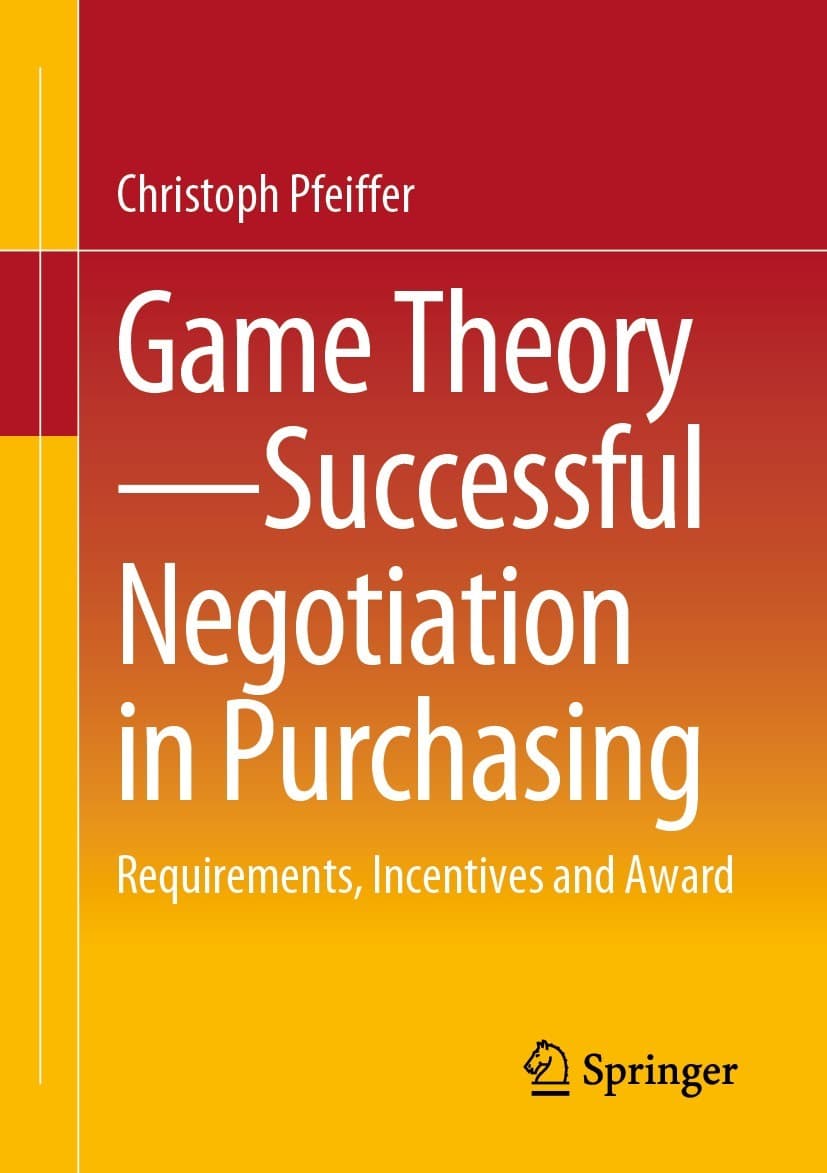
Christoph Pfeiffer is the author of the book on game theory in purchasing (Springer) and a co-author of the recent „Theorie des rationalen Bauherrn“, written with Friedrich Prem and Prof. Dr. Christian Rieck.

The Competitor – every issue, freely available.
Our newsletter, ready to read online: practical negotiation knowledge for significant cost reductions and stronger negotiation skills for your procurement team – all past issues in the archive.
Improve your Negotiation IQ
Under cost pressure and sure there's more on the table in your negotiations? Test your personal Negotiation IQ now and get qualified recommendations for your negotiation success.
Test your knowledge